I have yet to find the large format Tableland Rd negatives that I referred to in the previous post. Maybe I was mistaken in that I never made any? Maybe I only imagined that I made them. However, I do remember being in eastern Mt Lofty Ranges in the VW Kombi on day trips with the 5×7 Cambo. I also recall photographing with the 8×10 SuperCambo as well as scoping with a 35mm Leicaflex SLR, whilst driving along Tableland Rd. I also remember thinking at the time that I reckoned I was pretty hip using an cumbersome and heavy 8×10 view camera as this surely was what photography was all about. Crazy huh.
I remember being really shocked by how barren and bleak I found the Tableland /eastern Mt Lofty Ranges landscape. I couldn’t shake off the feeling that I was looking at a damaged landscape; one that had been damaged from the land being cleared for grazing. This opened up a perspective on how the country had been treated. My concern with the landscape was a long way from those current in the art world at the time, and it would have been seen as old fashioned and pre-modernist, if not part of a reactionary nationalism that postmodernists were effectively deconstructing.
I cannot find those 35mm negatives either. The most plausible option is that both sets of negatives may not have been just misplaced: I could have quite easily lost them whilst shifting houses over the years. I’ll keep looking.
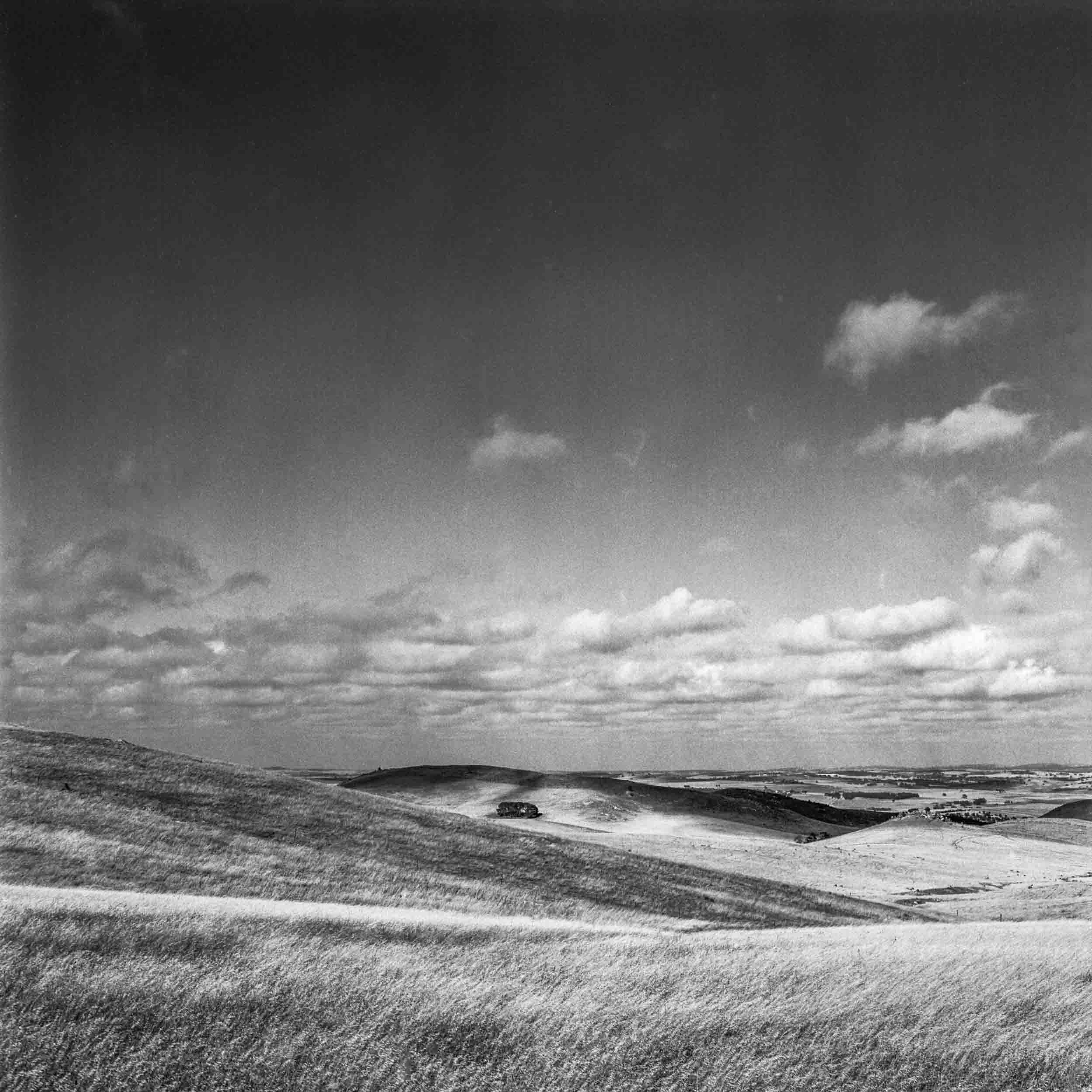
Some of the 6×6 film negatives from Tableland Rd are not in a good condition as they had been left in a shed for a number of years. I’d put photography aside during the mid-1990s to around 2010 and forgot all about what I had done. 2010 was roughly the time when I tentatively started photographing again. After reconnecting to photography I was eventually recalled, and wondered about, the body of work that I made in the 1980s-90s.
When I looked at this archival work I could see that my concern was with interpreting history, but not an art history shaped by the October journal in New York. The work was off-centre to, and outside of, the modernist art institution with its linear narrative history of art, in which the history of style moves from the past to the present. History means story or narrative and realism is soaked in this history because the postmodernism of 1990s is an inverted modernism: it appeared to oppose the assumptions of modernism — the desire not to do Greenberg — but drew for its self-understanding from modernism’s process of negation that emerged through a judgement to eject realism from the art canon formation.
History is not just narrative of remarkable occurrences in the distant past as it is a continual activity.It is s not only the account of past events but the events themselves. History is contemporaneous; history is now. So this body of work is also now –after the demise of postmodernism. If the art
from the past continues to inform our present-day culture, then the value of past art needs to be critically re-established in and for the present. A present in which the loss of art funding has meant the decline and dismantling of not-for-profit alternative, artist-run space in which to exhibit unconventional work.