Boom and bust.
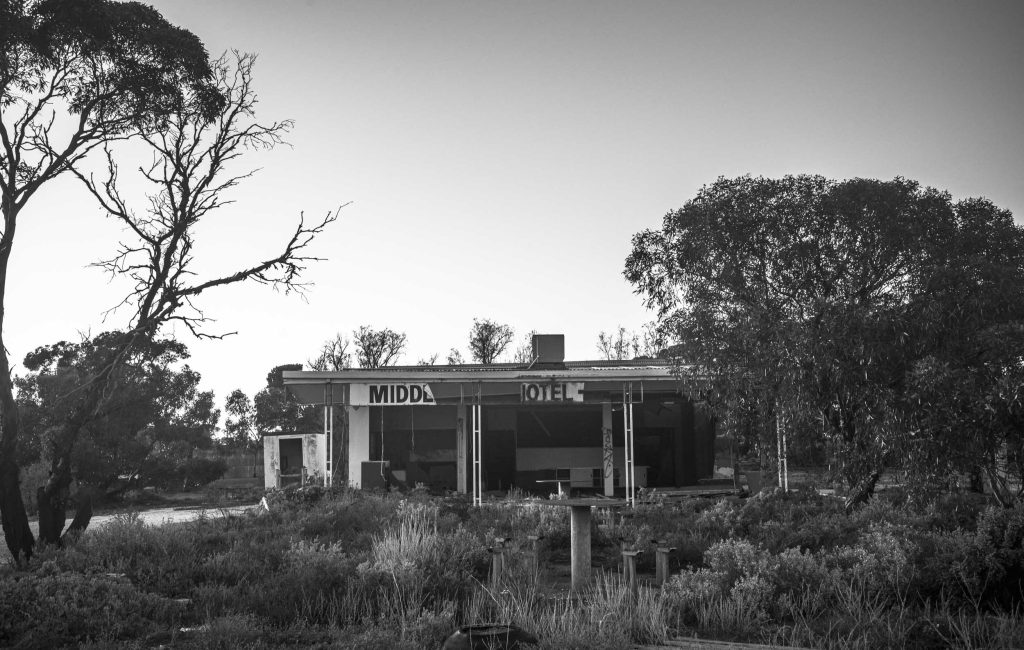
Then around 15 years latter the Iron Monarch mine re-opened with the iron ore being exported as well as being used for smelting at the Whyalla Steelworks. The town remained a ghost town though, a number of the deserted houses were still standing, and they were a stark reminder of what once had been.
In 1998 my experience was unlike the Romantics with their ruins of Greece or Rome. There was no element of nostalgia in the aesthetics of the Iron Knob ruins, nor did I have a sense of melancholia for what had passed. My experience had a suggestion of the sublime — not Kant’s conception though. Though the Kantian sublime resides not in art but only in the presence of nature: the dynamic sublime refers to the mind feeling the presence of great power in nature (mountains, gorges, storms, deserts, oceans, earthquakes) but the imagination is unable to adequately represent it, leaving us weak and vulnerable; then the subject discovers its powers of self-reflection and the soothes the pain and distress by affirming its superiority over nature’s appearance as other with its promise of reconciliation and thereby redemption.
Thus the myth of progress — the steady perfection of human capabilities and realization of human dignity. Sublime natural disasters (eg., The Lisbon earthquake of 1755) were comprehensible and human reason and dignity could claim to be superior to nature. However, in the 20th century it is the industrial genocide of Auschwitz with its terror and extreme violence that shatters the myth of progress and the superiority of human reason and dignity. That catastrophic history ends the Kantian sublime leaving us with the sublime as a genuine and distinct mode of experience.
The sublime migrated from nature into modernist art in the 20th century and it becomes a historical constituent of art where it functions to delimit art from the ‘arts and crafts’. This allow distinction to be made between the sublime in the sphere of art and actual historical catastrophe, such as Hiroshima, which employs form or imagery which successfully invokes such overwhelming associations. In the postwar avant garde visual arts (Joseph Beys) deployed negative strategies for confronting catastrophic history. The formlessness, alterity, abstractness and dissonance of modernist works of art enable them to allude to what Lyotard says is the presentation of the unpresentable and invisible.
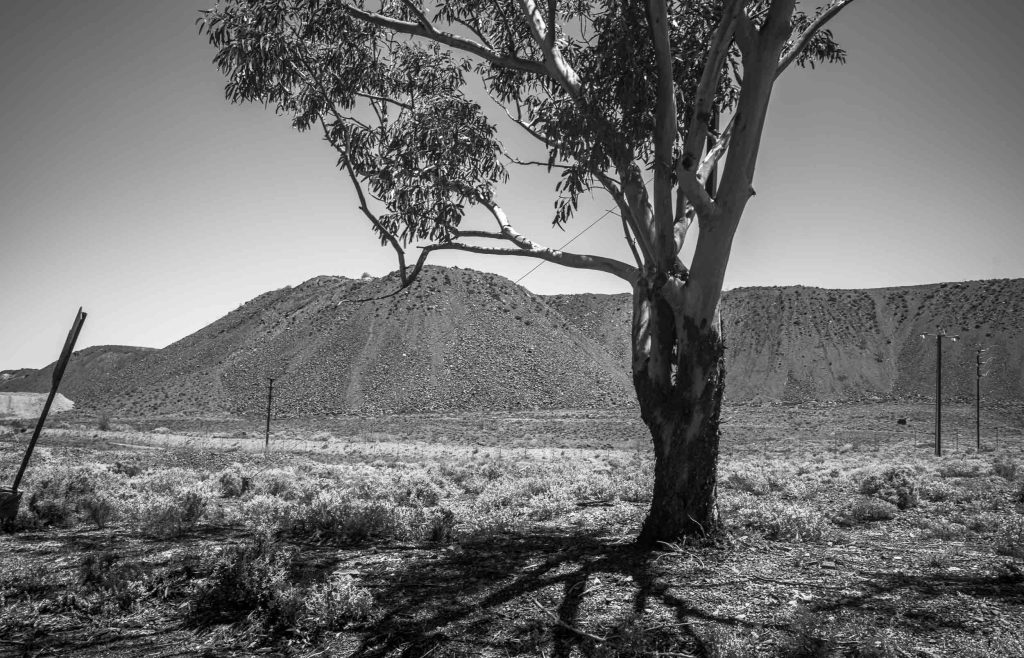
My experience at Iron Knob was about the object: the stark contrast between the promise of the technological power of mining in industrial capitalism to transform nature to generate financial wealth and its subsequent laying waste to, and destruction of, a landscape coupled to the damaged to the human flourishing of those who were required to work and live in Iron Knob’s harsh and barbarous conditions organized around state power. It was a recoil from this kind of domination. A recoil more in the way of a primordial bodily shudder, but also awe at the power and sweep of capitalism in transforming and polluting the earth.
I just couldn’t photograph that sense of the sublime with its remembrance of the suffering that domination, and ultimately a dominating society, inflicted on nature and people. How can photography negate the dominate narrative around mining and the means end relation of its instrumental reason regime and the intransigent world it confronts? Maybe photographing the fragments of some broken glass lying on the ground near a ruined building would provide an image that intimates or anticipates the way that this reality came to be experienced?
Leave a Reply